Welcome to the new format of our Night Sky blog articles. Going forward we will be focusing our night sky articles to the four different seasons and highlighting what things you can see in the night sky during those months.
Spring is arguably the quietest season for stargazing, but we have just passed the March equinox so there is a great stretch to the evenings now. This means the sky will start getting darker later in the evening and you’ll have to wait slightly longer before the sky will be fully dark. Don’t forget when you’re stargazing you must let your eyes adapt to the dark, and if you desperately need to look at your phone for somethin g, remember this will hinder your vision and you’ll have to let your eyes adapt again.
There are three notable constellations you’ll see in the Spring night sky and these are Leo, Boötes and Virgo. Let’s have a quick look at them:
Leo
Leo the Lion is one of the signs of the zodiac and the most iconic of the spring sky constellations. When you’re trying to find it in the night sky look for the backwards question mark! This backwards question mark is also known as the sickle and is a prominent asterism in its own right.

Looking South at roughly 11pm you will be able to see Leo in the night sky. Look out for his backwards question mark shaped head! Credit: Heather Alexander/Stellarium
Leo at a glance:
- The brightest star in the constellation is Regulus. The spectroscopic binary Regulus A consists of a blue-white main-sequence star and its companion is a pre-white dwarf.
- Leo is visable almost everywhere on Earth except for Antarctica!
- Deep sky object: Leo triplet (M66, M65 and NGC 3628). The Leo triplet is a small group of galaxies about 35 million light-years away. In order to see this deep sky object you will need a more powerful telescope and a good camera.
- The Leo Ring: Area of cold hydrogen gas discovered around Leo in 1983. The GALEX satellite detected ultraviolet emissions that astronomers at Johns Hopkins University and the Carnegie Institution for Science interpreted to indicate star creation in newly forming dwarf galaxies in a 19 February 2009 Nature paper. In 2010, it was suggested that the gas was not primordial, but instead the result of a galactic collision between the two galaxies with which the ring is closely associated.
Boötes
Boötes the Herdsman is one of those rare constellations that looks like the thing it represents. The most notable star within the constellation is Arcturus and is can be found by using the handle of the Plough (The Big Dipper). If you extend the handle of the Plough down towards the horizon, you will eventually arrive at Arcturus. It is the fourth brightest star in the night sky, so it is pretty easy to spot.

Bootes the Herdsman contains the 4th brightest star in the sky, Arcturus. You can spy it in the south at around 11pm on 7th April. Credit Heather Alexander/Stellarium
Boötes at a glance:
- The Boötes Void, also known as the Great Void, or Super Void, can be found in the region of Boötes. The void was originally discovered by Robert P. Kirshner, Harvard College Professor of Astronomy, in 1981, as part of a survey of galactic redshifts. By now, it is known that there are at least 60 galaxies in the void. American astronomer Gregory Scott Alderling once observed, “If the Milky Way had been in the center of the Boötes void, we wouldn’t have known there were other galaxies until the 1960s.”
- Deep Sky Object: NGC 5466 is a globular cluster first discovered by William Herschal in 1784 and is 51,800 lightyears away from the Earth
- Arcturus is a red giant star in the latter stages of its life. It is also moving a whopping 122km p/s, which is 272,907.27 miles per hour
Virgo
Virgo is the second largest constellation in the night sky. The only constellation larger it is Hyrda the Watersnake. You might already be familiar with Virgo and it is one of the 12 signs of the zodiac. To give you an idea of the size of Virgo in the Sky, it takes the Sun 44 days to travel through Virgo on its celestial path. The brightest star in this constellation is called Spica. The remaining stars are quite faint. The best way to find Spica is to follow the handle of the Plough (also known as the Big Dipper), and arc to Arcturus, the brightest star in the constellation Boötes. Once you reach Arcturus, you travel down in a straight line to Spica, you “spike” to Spica. In Latin, Spica means “ear of wheat,” and represents the grains that Virgo is always drawn holding.

Looking East at 11pm on 15th February, Virgo will be low on the horizon, but you should be able to see the main body of this constellation. Don’t forget it’s brightest star is called Spica. (Image Credit: Heather Alexander/Stellarium)
Virgo at a glance:
- Spica is the fifteenth brightest star in the night sky, and is a spectroscopic binary and rotating ellipsoidal variable, a system whose two main stars are so close together their mutual gravitational interaction has made them egg-shaped rather than spherical
Lyrids Meteor Shower
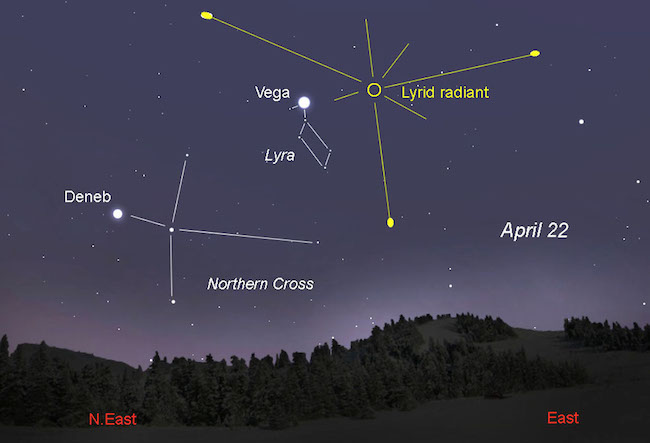
The Lyrids meteor shower will occur from 16th-25th April this year. Its peak is on 22nd April this year, so keep your eyes peeled. The meteors will appear to radiate from the constellation of Lyra, but they will appear across the night sky. The parent comet that is associated with the Lyrids is the long-period Comet, C/1861 G1 Thatcher. The lyrids is the oldest recorded meteor shower in history, with the first record of it being noted down in 687 BCE. Comet Thatcher has roughly a 422-year orbit and will next be seen in our skies in the year 2283.
Eta Aquarids Meteor Shower

If you miss the Lyrids meteor shower, you have another chance to see one in May. Active from 19th April – 28th May, the Eta Aquarids will hit their peak on 6th May. These meteors will appear to radiate from the constellation of Aquarius but much like the Lyrids, they will appear across the night sky. This shower also favours the Southern Hemisphere more but will be visible low in the sky in northerly latitudes in the pre-dawn hours. The parent comet of the Eta Aquarids meteor shower is none other than Comet Halley, the most famous comet in our solar system. Comet Halley will appear in our skies again in 2061.
What’s going on with the Moon?
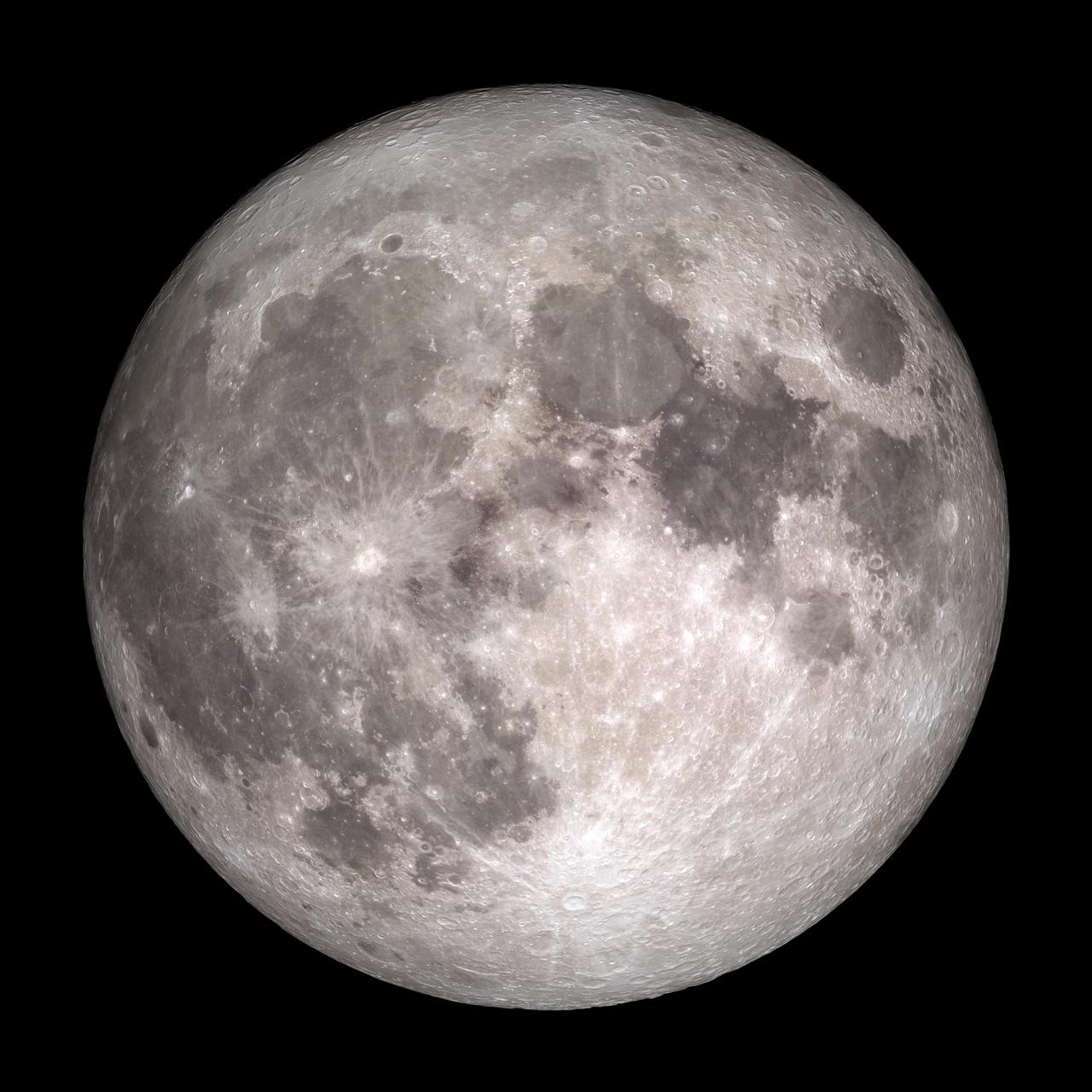
In the spring season, the Moon will be full on:
- 2nd April – The Pink Moon
- 1st May – The Flower Moon
- 31st May – Blue Moon
The full Moon on 31st May is one of the illusive Blue Moons. You may already be familiar with the phrase “once in a blue Moon,” and this refers to exactly this. A Blue Moon occurs when the Moon is full twice in one month. It is a rare enough occurance, but does happen every few years.
Planets in the Night Sky


Venus. Credit: NASA
Make sure you look out for the planets that will be visible in the night sky this spring.
In April you will be able to see Jupiter and Venus. Venus will be in the western sky after sunset, and Jupiter will be high in the sky in a south westerly direction. If you are trying to identify a planet in the night sky, make sure you look for a star that isn’t twinkling.
In May Jupiter and Venus will still be visible, however Venus will be in the morning sky as opposed to the evening sky.

2 Comments
Kasia · April 29, 2026 at 22:59
Hello
Is it possible to come and look at planets and stars through the telescope at your place ?
Heather Alexander · May 7, 2026 at 11:17
Hi Kasia, thank you for getting in touch with us. In Autumn and Winter we host public stargazing evenings where you can come and use our telescopes to do some stargazing. In Spring and Summer the night sky doesn’t get full dark until very late so we don’t run these evenings during these seasons. Keep checking our website as we will announce the dates for the upcoming stargazing evenings for Autumn and winter in August time.