On Wednesday 12 August 2026, we will have the chance to witness one of nature’s most spectacular celestial events, a partial solar eclipse. From Armagh, the Moon will cover approximately 94% of the Sun at maximum eclipse, making it one of the most anticipated eclipses visible from Ireland in decades.
A solar eclipse occurs when the Moon passes directly between the Earth and the Sun. Although the Moon is 400 times smaller than the Sun, it is also around 400 times closer to Earth, allowing it to appear almost exactly the same size in our sky. This remarkable cosmic coincidence means that, from time to time, the Moon can temporarily partially or completely block the Sun from view, casting its shadow on our planet.
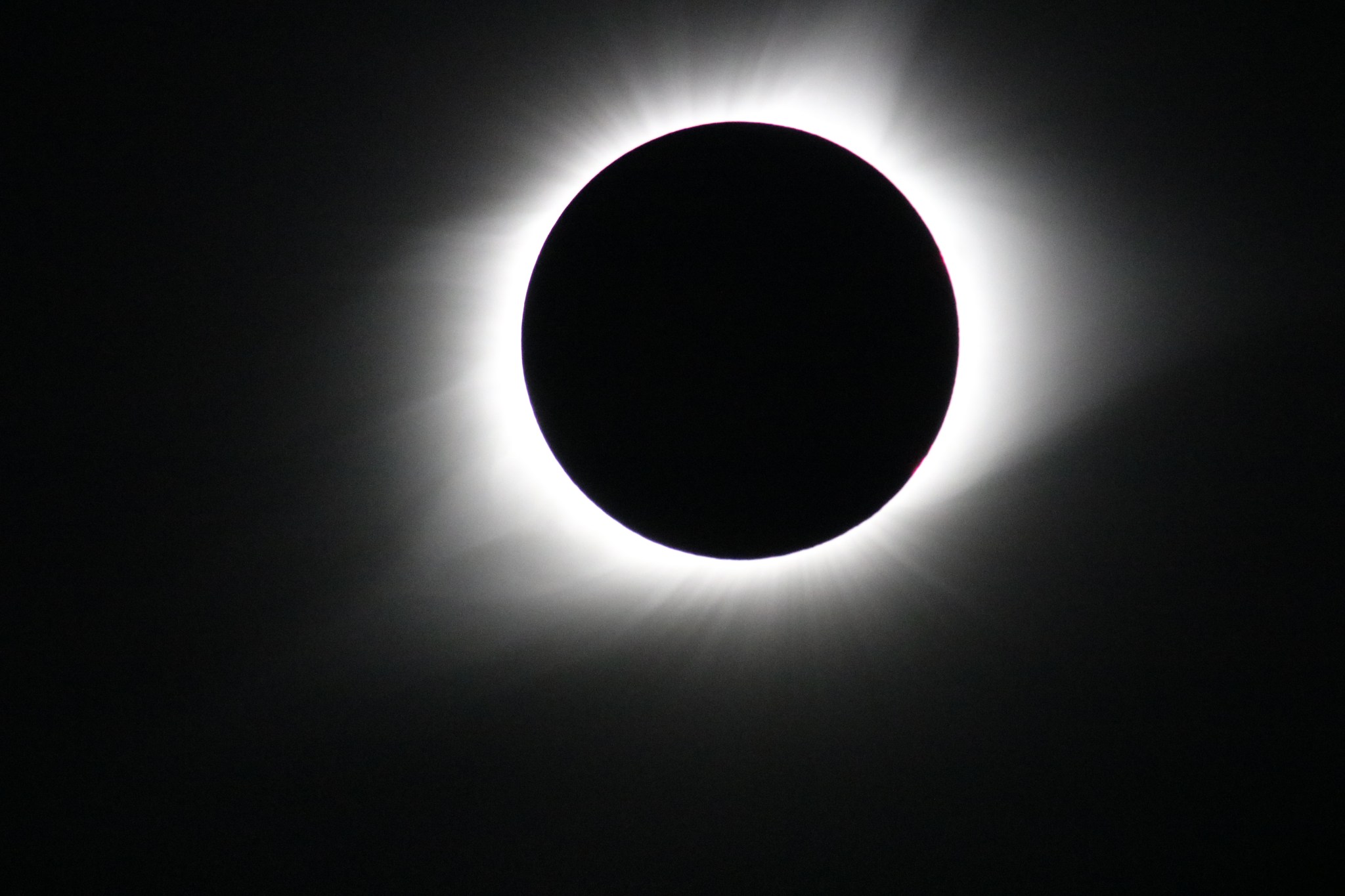
A view of the Aug. 21, 2017, total solar eclipse from Madras, Oregon. NASA/Gopalswamy
The eclipse on 12 August 2026 will be a total solar eclipse for a narrow path stretching across Greenland, Iceland and northern Spain. This is called the path of totality. Here in Armagh we will experience a partial eclipse. The eclipse will begin at approximately 6:10pm, reach maximum coverage at around 7:08pm, and end shortly after 8:00pm. At its peak, only a thin crescent of the Sun will remain visible. The event will take place during the evening as the Sun gradually moves down towards the western horizon, which will create a beautiful sight as the eclipsed Sun sits low in the sky.
For many people on the Island, the last memorable solar eclipse was the partial eclipse of March 2025, when around 40% of the Sun was covered. While impressive, the 2026 eclipse will be on a completely different scale. In fact, it will be the deepest solar eclipse visible from here since the famous total eclipse of August 1999, which brought thousands of visitors to Cornwall and parts of southern England.
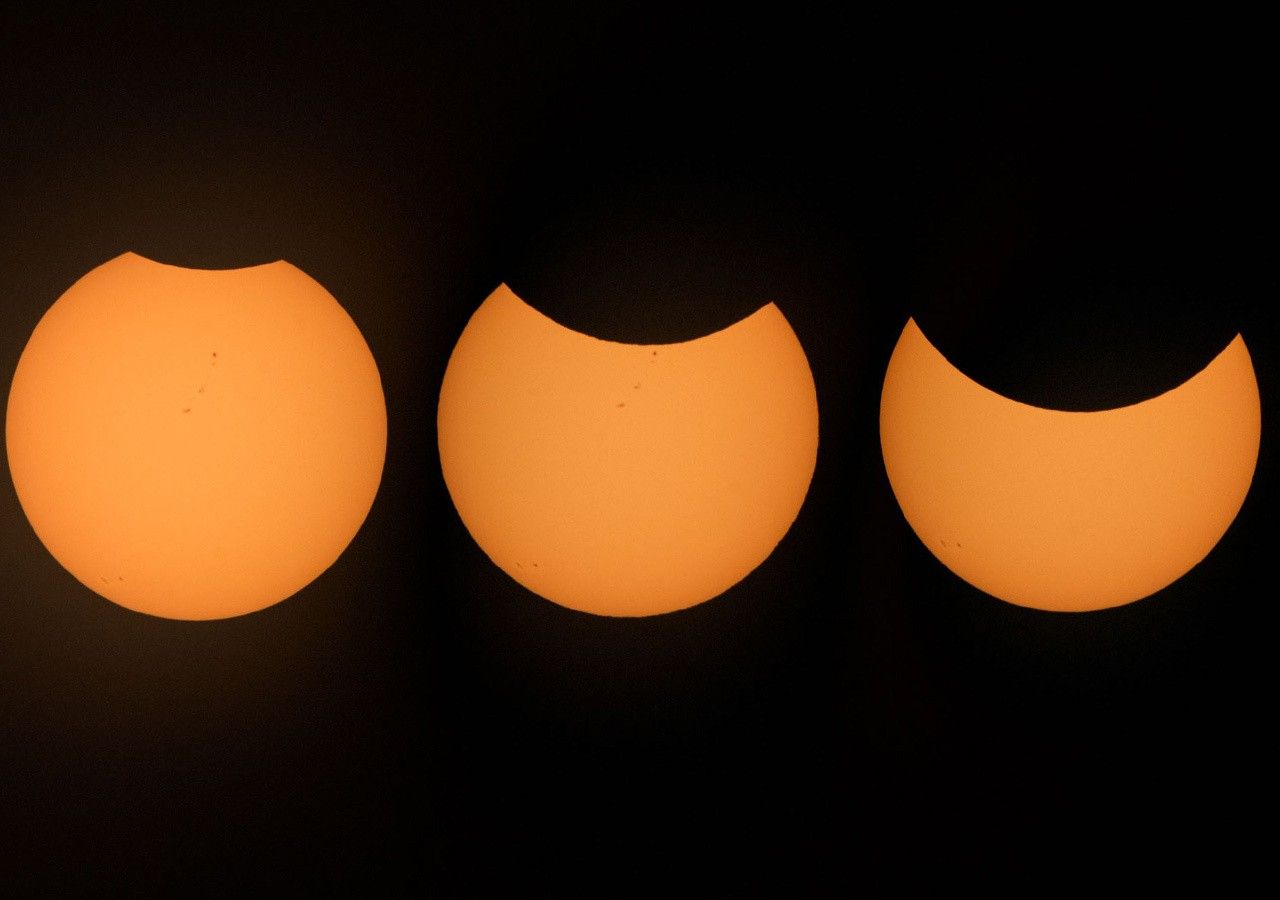
Images of the Sun in three different stages of an eclipse. Credit: NASA
Solar eclipses have fascinated humanity for thousands of years. Ancient cultures often viewed them as omens or supernatural events, while modern scientists use eclipses to study the Sun’s atmosphere and the precise motions of celestial bodies. Even today, eclipses remind us that we live in a dynamic Solar System, where the Earth, Moon and Sun are constantly moving in an intricate celestial dance.
To celebrate this rare event, Armagh Planetarium will be open from 10am until 8pm, offering a full day of family-friendly activities, hands-on science demonstrations, space-themed fun, dome shows and special eclipse events. Visitors will be able to learn about the science of eclipses, discover how astronomers safely observe the Sun, and enjoy a programme of activities suitable for all ages.
As eclipse time approaches, our team will provide safe solar viewing opportunities. It is important to remember that the Sun should never be viewed directly without approved solar filters, even during a partial eclipse. Planetarium staff will be on hand to help visitors observe the event safely and answer questions about the eclipse and the wider universe.

Be safe when viewing the Sun during the Partial Solar Eclipse. Credit: NASA
If you have not visited before you can also explore the beautiful grounds of Armagh Observatory, visit the twin cathedrals that dominate the skyline, or relax and have a stroll and a coffee in the nearby Mall area before joining us for the eclipse itself.
Of course, the one thing we cannot control is the weather. But whether the skies are crystal clear or partly cloudy, the eclipse offers a wonderful opportunity to come to Armagh Observatory and Planetarium and celebrate our place in the cosmos.
Join us on 12 August 2026 for an unforgettable day as the Moon takes a bite out of the Sun above Armagh.
Please Note: Looking directly at a solar eclipse can cause permanent eye damage. You must wear certified eclipse glasses or use indirect viewing methods to safely watch the event.


0 Comments